

And Now for Your Regular Programming
'America's Next Top Model' and the damage done to the female psyche

THE NETFLIX SERIES CALLED REALITY CHECK: INSIDE AMERICA’S NEXT TOP MODEL is a four-part documentary takedown of one of the early smash-hit reality TV shows. Young women moved through a series of absurd trials in hopes a panel of judges would declare them America’s Next Top Model. The notion was that the winner would go on to enjoy a high-powered career, which prevailingly did not happen. But for 15 years, ANTP was watercooler TV with sky-high ratings.
The show debuted in 2003, when my daughters were tweens, and the good news here is that America’s Next Top Model did not feature in our home entertainment habits. In fact, I had never watched a minute of it, having sussed out from the commercials alone that ANTP was likely to kill brain cells I couldn’t afford to lose.
But recently I found myself watching the documentary out of perverse cultural curiosity. What was the specific nature of the noxious messaging Tyra Banks and her cronies were pumping into the ether at the time, I wondered. What was being absorbed, exactly, by the show’s audiences?
The answer: The show was casually peddling body dysmorphia and stoking eating disorders.
America’s Next Top Model turned its fresh-faced contestants into self-assessing neurotics and sold the same to its audiences. Within a framework of invented drama dressed up as young women chasing their dreams, ANTM cashed in big on reinforcing that old myth that a woman’s value lies in achieving physical perfection as defined by outsiders.
No surprise there.
What makes the documentary alluring — in the way of National Enquirer headlines screaming at you in the check-out line — is its parade of former contestants telling their tales of abuse. Mixed in with typical reality-show melodrama were stories of sexual assault (I’d call one rape), and others about contestants undergoing dental surgery under duress. There was a photoshoot for which models dressed as the homeless and posed with actual unhoused people, and another where the models donned makeup to “switch races.” Loathsome stuff.
The real horror, however, is that millions of people, including children and adolescents, watched a parade of beautiful women being assessed, week in and week out, and often found wanting. The contestants were being told to maybe just eat the burger and leave the bun. They had their tiny waists measured and remarked upon. And the audience was ingesting the message.
I’d like to think that America’s Next Top Model was so over-the-top that it actually provoked critical thinking about what women were being told about their bodies, and maybe that occasionally happened.
More likely, though, this stupid program became just one more refrain in a terrible song we’ve heard on repeat since birth.
What does it all mean for women today? I think it means that no matter our age, no matter how wise or culturally aware, it is possible — with or without having watched this particular TV slop — we might still be carrying around some pretty corrosive mental programming.
TWO THINGS HAPPENED IN MY WORLD THIS WEEK. One was that I turned 65. Sixty-five! — how? (And the answer is good luck and the passage of time, of course!)
The second is that my husband and I watched My Cousin Vinny for the first time, during which 90 percent of my brain was being highly entertained while a small, familiar 10 percent was busy admiring Marisa Tomei’s lithe figure and wondering what it would be like — what it would ever have been like — to have a body like that.
This two-track viewing experience might be familiar to anyone who has struggled with The Food and Weight Thing (TFWT), but I confess that I thought it would have, y’know, kind of faded by the time I was eligible for Social Security.
Alas. Here we are. And honestly: Good. Because at least now I’m paying attention to that second track and getting curious about it.
With a geriatric twinkle in my eye (I’d like to think), I took that curiosity to my custom ChatGPT, and typed in the following:
Imagine that I just turned 65 and I were to tell you that for virtually all of my life — since I was a child — I have been enormously self-conscious and judgmental about my body, specifically my weight. I have achieved many things, enjoyed family and friends, had a good career. But always running in the background is an awareness of the size of my stomach or thighs, the difference between my body and the bodies of other women, what strategy I’m going to use today or tomorrow to “fix” myself. Imagine that I told you all that and asked whether you think it’s possible to shift my mindset to make myself more accepting of my body as it is.
TO WHICH CHAT RESPONDED: If you told me you were 65 and had carried that running commentary in your head since childhood, the first thing I would say is this: Of course you did. Of course it makes sense.
You grew up in a culture that has been relentlessly, creatively and profitably obsessed with women’s bodies. You didn’t invent that voice. It was installed early, reinforced often, and rewarded socially. The fact that it has been humming in the background for decades doesn’t mean you are shallow or vain or broken. It means you were paying attention.
The second thing I would say is this: Yes. It is absolutely possible to shift your mindset. Not necessarily into some Instagram-ready “I love every inch of myself!” place overnight. But into something saner. Kinder. Quieter. More spacious. Even appreciative. Even loving.
At 65, you have something you did not have at 25 or 35: perspective. You have evidence that your body was never the central story of your life. You achieved things. You loved people. You built a career. You had joy. And all of that happened while your thighs existed exactly as they were.
Our conversation proceeded, with Chat offering some simple steps for reframing my thinking.
It also added this, the first line of which made me laugh: At 65, your body is not an aesthetic project. (No kidding.) It is a companion. It is the vehicle that carried you through love, disappointment, work, children, loss, ordinary Tuesdays, extraordinary Fridays. You don’t have to adore it. But you can decide to stop being its adversary.
So, yes: I would have preferred to have reached this age liberated from old programming installed, in part, by coming of age during the Virginia-Slims 1970s and inhaling Glamour magazine — our era’s version of America’s Next Top Model.
I’d have preferred to have arrived by now at a more balanced and rumination-free mindset regarding my particular bag of bones. Most of the men I know seem pretty content with their bodies, on the whole. They, too, might watch My Cousin Vinny with eyes fixed on Marisa Tomei, but it’s hard to imagine they’re comparing themselves in any way to Joe Pesci or Fred Gwynne, or even the young Ralph Macchio.
With regard to body image, wise contentment isn’t yet where I find myself. Why is it so much easier to download these apps than to uninstall them?
Even so, I’m feeling optimistic. With a bit of work, more luck, and the the passage of more time, I might yet get there.
BOOK REVIEW
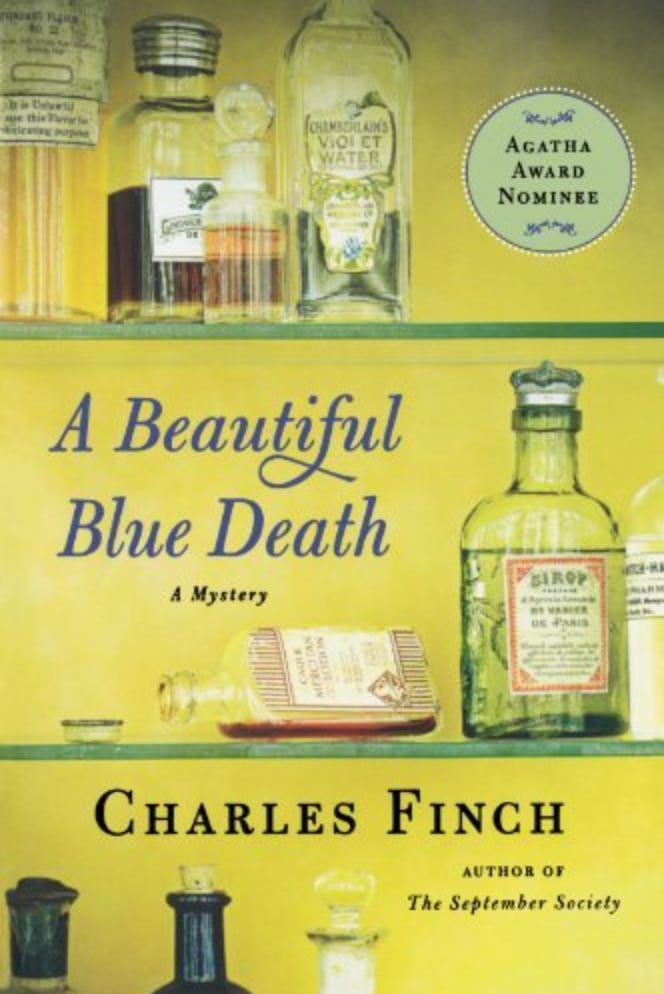
A Beautiful Blue Death
Charles Finch
In 1850s London, the wealthy amateur sleuth Charles Lenox is asked to apply his skills to the mysterious death of a housemaid who has been employed at the home of an acquaintance. Lenox quickly discovers the maid has been poisoned, and sets out to find the who and why of it all. This is the first in Finch's Lenox series, and it has a genial Sherlock Holmes feel to it (complete with a wise sidekick — Lenox's butler, Graham). It’s a standard, old-fashioned whodunnit and a pleasant diversion from life in the 21st Century.
Your writing so resonates with me. I am 73. After a lifetime of yoyo dieting, weight swings, my mother's pronouncements of How pretty I could be if I lost some weight, after two extraordinary children,after 2 bouts of cancer which ultimately led to metabolic syndrome, ; I was recently diagnosed with Type 2 Diabetes. It will sound odd, but this chronic illness has turned off the judgemental voice in my head. Yes,I am taking injections to help decrease triglycerides and help with weight loss but I have been able to view myself with more loving eyes and resolve to care for it than I've ever had previously. It's like meeting up with a long-lost childhood friend and tenderly embracing, filled with gratitude for all the sweetness of shared memories and experiences. Next step...
I think you are my younger sister (I'll be 75 in April) from another mother! The weight saga, the ANTM insanity - yes, ma'am. Right there with you. But I have to say that My Cousin Vinny is my all-time favorite funny movie and the whole cast, including the sylph-like Marisa Thomei, is brilliant. Yoots?